
Sixteen retailers, CHF 28 million, and the fee suppliers paid to stay on the shelf
For the suppliers of sixteen Swiss retailers, being on the shelf had a price of its own.
The retailers sold everyday goods and bought through one purchasing cooperation, called Markant.
Markant negotiated discounts with the suppliers on their behalf.
It also sold those suppliers a bundle of services.
A supplier who wanted to supply the retailers had to buy the bundle, and its price kept rising.
When suppliers refused the higher terms, the retailers could act together, up to taking products off the shelf.
Part of what the suppliers paid for the services went back to the retailers as rebates.
The suppliers were not shown this.
On 8 July 2025 the WEKO, the Swiss competition commission, published its decision, and it drew a line between two things.
Negotiating discounts together is allowed, and so is enforcing them together.
In the commission's view, the cooperation lets the retailers build countervailing power, and it lowers purchase prices.
The rebates hidden in the service fees are a different matter, and so is the collective pressure tied to them.
The commission called this an impermissible price agreement on the buying side.
The sixteen retailers were fined about 28 million Swiss francs in total.
According to the Swiss broadcaster SRF, Markant itself was not fined, because it does not compete in the market directly, and suppliers may no longer be required to buy paid services from it.
Markant rejects the decision.
It calls the procedure one-sided, says its retailers together hold less than ten percent of the market, and announced it would take the case to the Federal Administrative Court.
The decision was not final when it was reported, and I have not found how the appeal ended.
The commission's release also does not say how long this ran, or how far the price of the bundle rose.
What I find interesting is where the line sits.
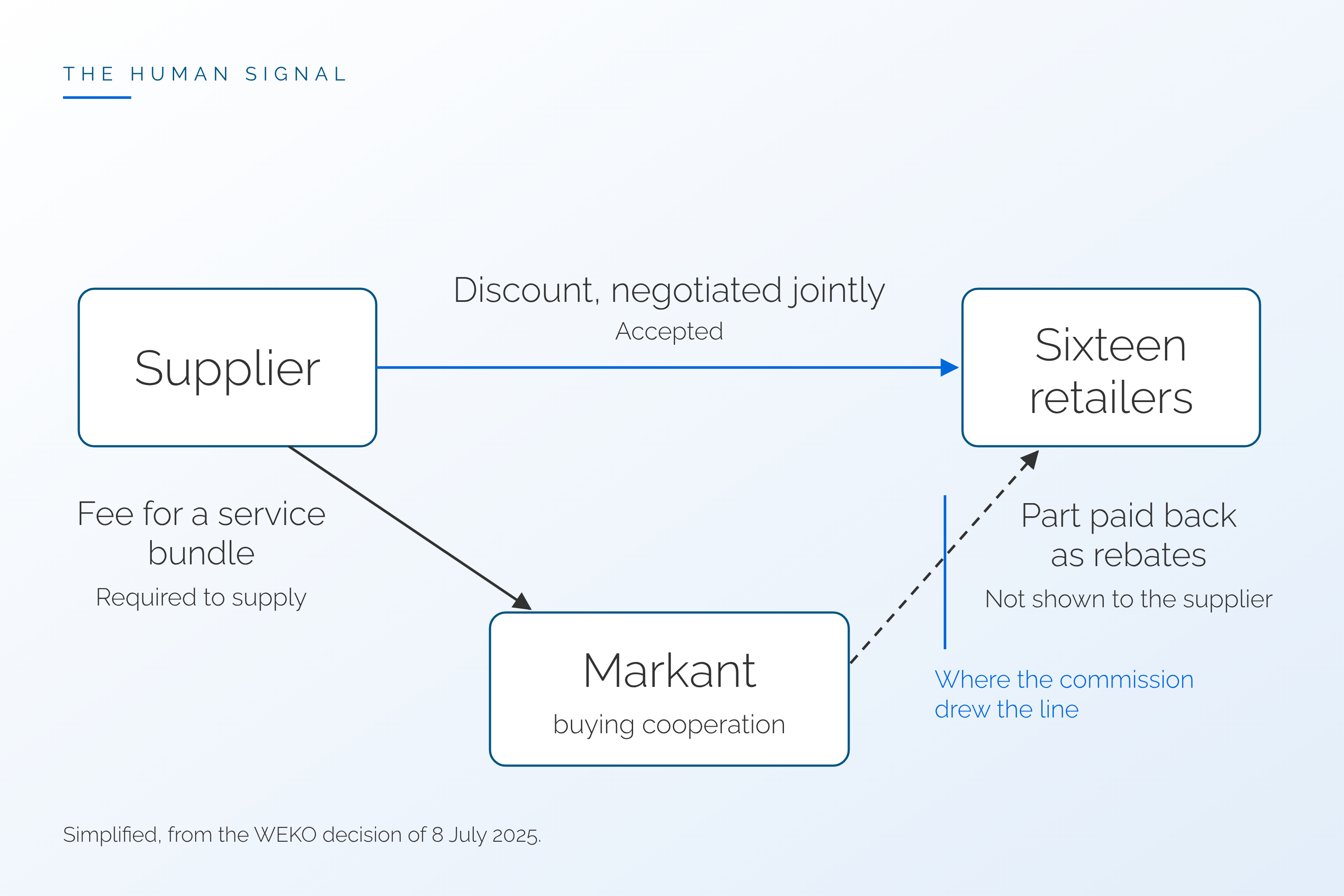
The discount on the goods was negotiated with the suppliers, and the commission accepted it, joint enforcement included.
The line fell at a fee around the goods: sold as a service, made a condition of being on the shelf, and partly paid back to the buyers where the supplier could not see it.
In my years in retail I saw the other side of this.
Part of what a supplier negotiates is what happens after the order: where the product stands, and how it is shown.
That part is not written in the order.
A service sold together with the listing sits exactly there.
It is one more condition on the same negotiation table, and like any condition, it can be met with open questions.
What does this service deliver for us this year?
How will both sides see that it was delivered?
Can it be negotiated on its own?
And where does the money go once it is paid?
Tina
In January, my newsletter here on LinkedIn, The Human Signal, starts a new season: eight editions, each on one negotiation topic.
